PRESS SHOP INSPECTION
Detect surface defects on highly reflective stamped metal parts in real time. Robust against challenging lighting conditions and production variability, the system enables early defect detection, reduced scrap rates, and lower internal failure costs.
Gain real-time visibility into part quality with automated inline inspection, defect mapping, and production-ready AI tailored for automotive press operations.

Inspect every stamped part directly on the production line without impacting throughput. Reliable defect detection at full press-line speed — up to 18 PPM with zero impact on takt time.

Detect cracks, wrinkles, splits, neckings, and surface imperfections down to sub-millimeter dimensions on highly reflective stamped metal surfaces.

Automatically localize and map detected defects on each part, enabling trend analysis, process monitoring, and faster root-cause identification.

Inspection hardware, imaging strategy, and AI models are tailored to part geometry, production speed, surface characteristics, and line layout requirements.
Most forming defects originate early in the press line — long before final assembly — and small issues at this stage quietly shape downstream quality. Fast stroke cycles, reflective metal surfaces, and shifting die conditions make real-time visual inspection difficult in any sheet-metal forming environment. As a result, cracks, wrinkles, thinning, and die-related distortions often move forward unnoticed, increasing scrap, rework, material waste, and production costs across the entire operation.
.png)
Reflective metal and fast stroking cycles make manual inspection unreliable, causing defects to slip.
.png)
Stopping the press is costly, and sampling misses intermittent issues — letting defects accumulate unnoticed.
.png)
Missed defects multiply scrap, rework, energy waste, and takt-time delays across the plant.
.png)
Without early detection, hundreds of bad parts can be produced before die-related issues are recognized.
Press shop operations face recurring issues such as cracks, wrinkles, thinning, die marks, and surface distortions that often escape manual detection.
Robolaunch Vision AI accurately detects all major stamping defects at line speed, helping manufacturers prevent scrap, rework, and downstream quality failures.
We adapt our AI system to your exact stamping line — from defect references to lighting conditions — ensuring accurate detection from day one.
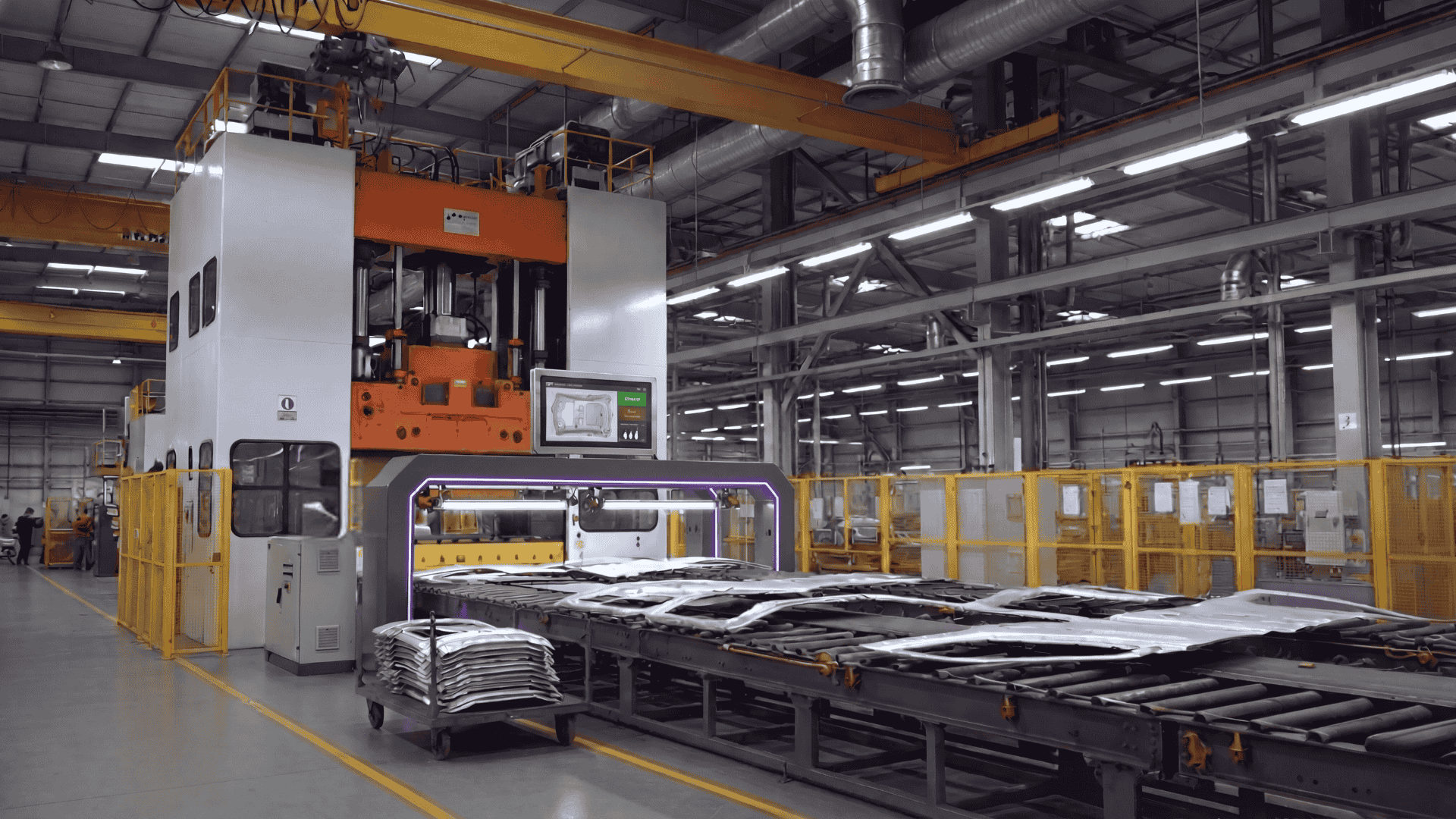
We collect your critical defect samples, material details, and lighting conditions to recreate your stamping environment with high accuracy.
We generate a photorealistic digital twin of your parts and produce thousands of realistic defect variations to fine-tune the AI model.
We install the camera–lighting setup on your press line, deploy the optimized model on the edge PC, and calibrate it for stable line-speed detection.

Vision AI systems designed to inspect, adapt, and scale across manufacturing lines.