VISION AI FOR AUTOMOTIVE MANUFACTURING
Inline Vision AI systems for Press, Body, Paint and Final Assembly. Designed to detect defects before they become downstream cost.



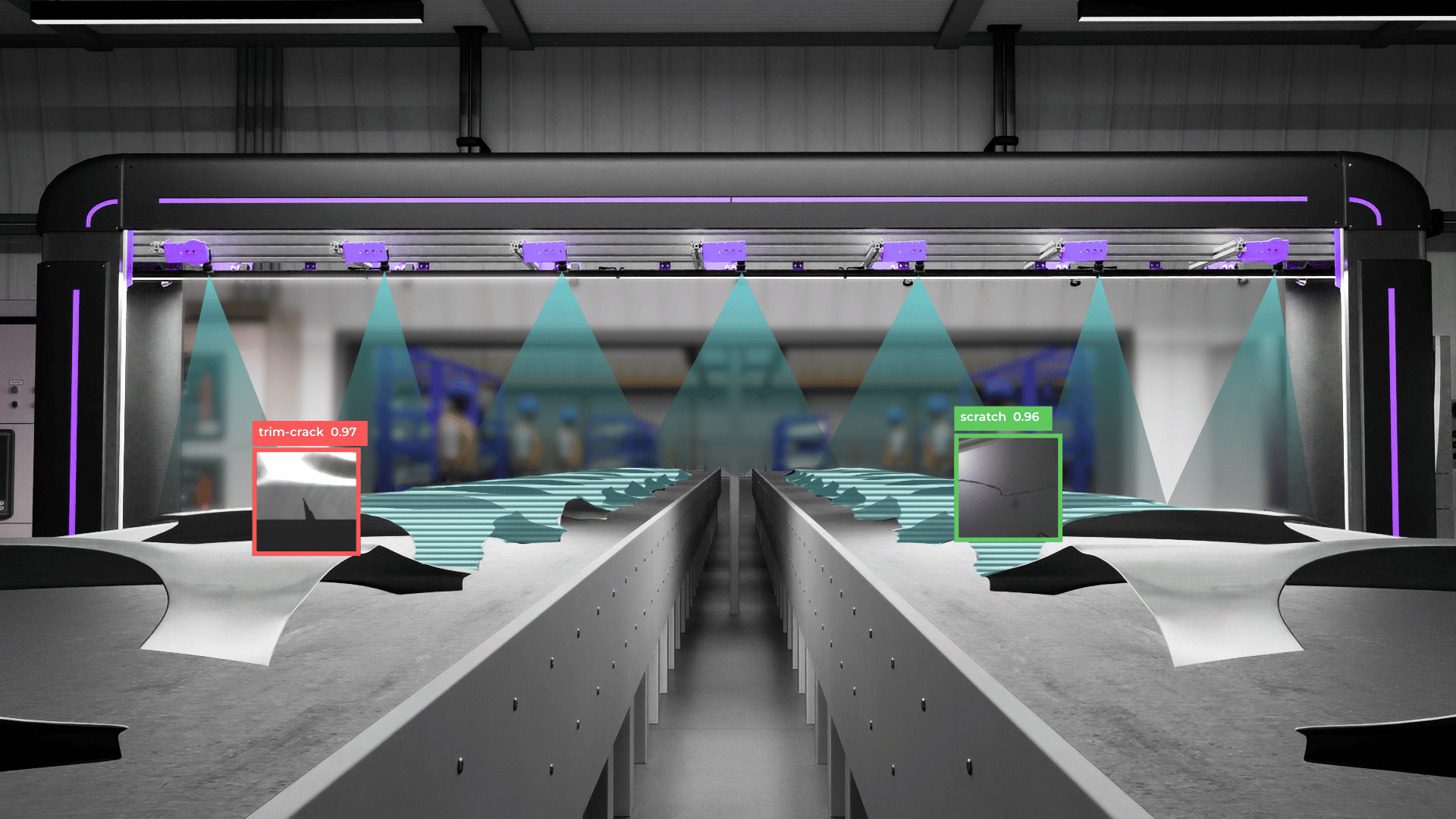
A defect originating in Press or Body can continue through multiple production stages before being identified; adding processing, rework and scrap costs along the way.
robolaunch moves inspection closer to where defects originate: detecting them in real time, fully inline, before additional manufacturing value is added and without disrupting production flow.
Material Defects
Forming Defects
Sub-Assembly Defects
Paint Defects
End-of-Line Validation
Internal
Failure Costs
proactive process-level quality management
External
Failure Costs
reactive final validation
.png)
Industrial vision systems can quickly become complex as camera count, lighting, cabling, and mounting requirements grow. robolaunch uses a modular architecture with integrated camera, lighting, power, and data components to simplify installation and maintenance, while allowing the system to scale and adapt to different production-line layouts.
.png)
Inspection requirements change across parts, defects, and production stages, while real defect data is often limited. robolaunch uses synthetic defect generation to create application-specific training data and adapt Vision AI models to new geometries, defect types, and quality requirements—without redesigning the inspection system.
Our vision-inspection workflow begins with cloud-side AI Infrastructure, where we capture real production conditions, build a digital twin of your station, and train the model using large-scale synthetic defects. Once optimized, the model is deployed to the Vision AI Engine on your production line, running in real time at full cycle speed with sub-millimeter accuracy.
.png)
We capture real production conditions for accurate modeling.
Thousand-scale defect dataset created in simulation.
AI tuned to your production surfaces.
Inspection hardware installed and calibrated for your line.
Vision AI Engine performs real-time defect detection.
.png)
These stages capture real production conditions, build the digital twin, generate synthetic defects, and train the model using GPU-accelerated compute — all performed off-line to prevent production disruption.

The optimized model is deployed to the inspection hardware at your station, running inline at full cycle speed and delivering real-time defect detection, visualization, and quality insights.
FOR AI DEVELOPERS _
An end-to-end AI development platform to build, simulate, and deploy intelligent applications — powered by GPU orchestration, real-time collaboration, and flexible on-prem/cloud deployment.
FOR FACTORY QUALITY TEAMS _
A production-ready AI inspection engine built for automotive manufacturing. Detect every defect, at every station, with zero line redesign and fast deployment.

Vision AI systems designed to inspect, adapt, and scale across manufacturing lines.
